Back to Saint Francis Dam Driving Tour - Overview
Kemp Siding Edison Road Camp - 1:18 AM; 20-30 ft wall of water; 17.5 miles downstream
The flood roared down from Castaic Junction toward Del Valle in the Santa Clara River Valley on its path to the Pacific, now heading due west and still over 20 feet high.
Story 7 of 14
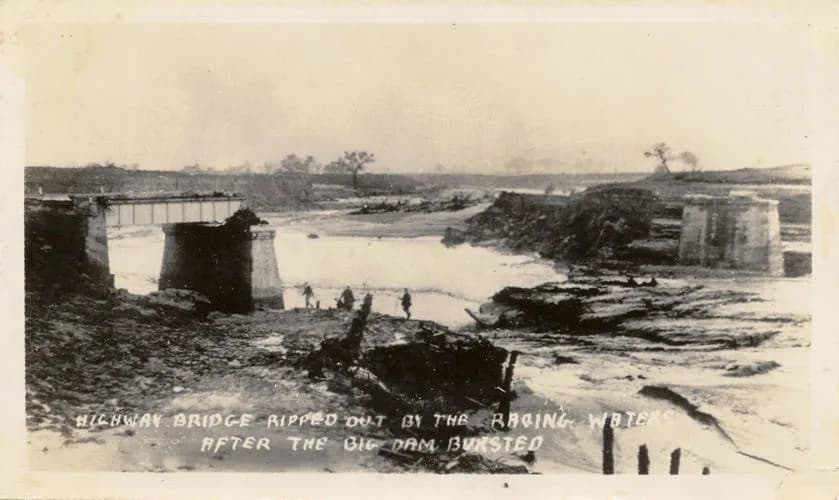
It wiped out Joe Gottardi's Pecan orchards as well as his Blue Cut field. His home, wife and daughter were all taken from him by the floodwaters. All 1720 acres of his agricultural and livestock land were totally destroyed by the thirty foot wall of mud, boulders and debris.
Some 150 Edison linemen had been stringing a power line from downstream Saticoy to Saugus. They were camped on the opposite bank of the dry Santa Clara River bed from Blue Cut, an outcropping of bedrock just east of the L.A.-Ventura County line. The floodwaters lashed against the rock and whipped back over the unwarned workers who'd been asleep in their tents, dealing them a double dose of disaster. Eighty-four, over half of the entire work crew perished in minutes.
"From our observations," Almer and George Newhall report on behalf their eponymous company, property owner Newhall Land, "it seem(s) to us that the terrific loss of life and damage caused to this construction camp was due to the backwash of the water when it struck the Blue Cut Promontory and was diverted first north and then southwards back across the track into the body of the stream again."
"One of the witnesses told us that the water, when the flood first struck them, must have been at least 20 feet deep; in fact the water marks on a remaining telegraph pole there seem to bear out his statement," they write.
The Newhalls' report is dated March 24, 1928, and accompanies photographs they shot along the flood path where it ran through their property from Saugus (Seco Canyon) to Piru.
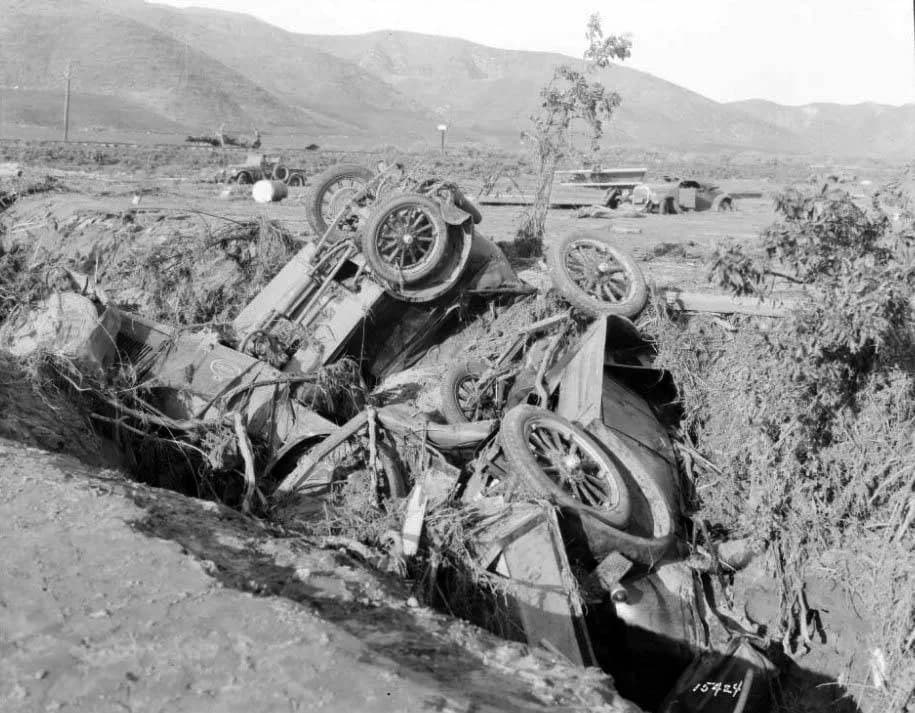
They describe how their photos "give some slight indication of the terrific force with which this backwash of the flood waters engulfed the men (at Kemp), showing respectively a freight car torn from its trucks and tipped over; a group of reels of copper cable weighing approximately 26,000 lbs. each moved from alongside of the railroad track out into the middle of the field 500 feet or more; and a close-up photograph of a few of the wrecked automobiles that belonged to the old construction gang. ... (Y)ou will notice these automobiles scattered all over the entire field and ... a steam crane being used to right some of them.
"An interesting point is that while the automobile bodies, machinery and tops were very seriously damaged," they note, "we did not see a single instance where one of the tires was broken."
Source: Photograph from the Edward C. Lamb collection, believed to have been created by his brother Henry C. Lamb. Henry's name alone is associated with this set of 30 St Francis Dam Disaster photos.
Henry C. Lamb was a graduate of Stanford University who worked for the Edison company. His descendants report (2014) that they do not believe he was present at the Edison camp at Kemp at the time of the disaster. Although they suspect Henry shot the photgraphs himself, it is possible he received them from a third party.
Edison Company’s temporary construction camp, which was located just west of the Los Angeles/Ventura County line at the Southern Pacific Railroad siding at Kemp. A 60-foot wall of water traveling at 12.5 miles per hour washed over the workers, as they slept in canvas tents on the northern bank of the Santa Clara River (Nichols 2002:37-42). The natural topography of the area created a huge whirlpool, resulting in significant loss of life. Eighty-five of the 148 men at the camp that night were killed (FA, 29 March 1928:1).
Wrecked autos belonging to some of the c. 150 men who perished at the Southern California Edison Co. Construction Camp just west of the Los Angeles-Ventura county line. According to the text, "you will notice these automobiles scattered all over the entire field and at the left a stream crane being used to right some of them. An interesting point is that while the automobile bodies, machinery and tops were very seriously damaged, we did not see a single instance where one of the tires was broken."
Original caption by Almer M. Newhall reads as follows:
No. 15 Present condition former So. Cal. Ed. Co. Camp
From Plate VI.
© Mapme © MapTiler © OpenStreetMap
Audio Narration
Tour Route
You are here
Experience This Story On Location
Download the History Cake app to experience this story with automatic audio narration as you visit the location.