Back to Sphinx Ranch Walking Tour
The early history of the Sphinx Ranch land and how it becomes William Allen's
An overview of the varied peoples who have lived upon and used the land of Northeastern Altadena and Eaton Canyon's waters. From pre-contact native populations to the early 1880's, when the William Allen family comes to farm and live on the alluvial fan upon which our neighborhood sits today.
Altadena, CAStory 4 of 17
As we walk up Pepper street towards Berendo and turn right, we can step back in time and put ourselves out to sea between Santa Catalina island and land that is now Santa Monica. We are on a spanish galleon and through our spyglass we see the alluvial fan spreading beneath the San Gabriels glowing with a skirt of bright orange spring poppies. This view was recorded by Captain Juan Cabrillo as he entered what is now Santa Monica Bay in 1542.
La sabanilla del oro the spaniards called the setting, the altarcloth of gold. Their log is the first mention of the lands which would become Altadena over 300 years in the future.
Native Americans lived in both the Eaton and the Arroyo Seco canyon mouths where oaks and acorns were plentiful and game abounded for centuries before the bearded white men came to the harbors and shores they already knew so well. The first inhabitants of the land that would become Altadena were the Hahamongna Tongva tribe of native americans who lived here at least 8000 years ago and perhaps as long as 10000 years BC.
They hunted rabbits and antelope and coyotes and gathered acorns and had major villages in both Eaton Canyon and the Arroyo Seco. The coastal live oaks delivered acorns and the presence of running water through the canyons brought the mammals of the mountains nearby. They traded with the Chumash to the north and, like the Chumash, used ocean going canoes to access Santa Catalina island and the Santa Barbara Channel. To the east, they traded with the Serranos and Chemehuvi and to the south, the Luiseno and Juaneno as well as the northwesterly canyon and valley dwelling peoples of the Tataviam and Fernandeno tribes.
The Arroyo Seco served as a sort of native peoples trading center as well as Bell Canyon in the San Fernando Valley and Santa Catalina Island. They lived for at least 80 centuries before being visited by European explorers and traders. California remained a mythical island somewhere in the great sea beyond until Juan Cabrillo sailed north by order of the Spanish Viceroy with three ships built in El Salvador. They were tasked with mapping the coast and trying to find a route to China as well as looking for the non-existent strait of Anian connecting the Pacific Ocean to Hudson's Bay. They would sail by Catalina and Channel Islands and San Pedro Bay in September and October and reach as far north as the Russian River in November before being turned back by inclement weather.
When first seen by Cabrillo in October of 1542 from Santa Monica Bay, the native Tongvans were conducting a rabbit hunt by burning low brush and herding the rabbits. Above the smoke from their fires, he could see a bright line of orange skirting the distant mountains and La Sabanilla del Oro was the first european description of what would become Altadena 300 years down a slow and pastoral road paved by the spanish. The spaniards would not be back to try to populate and defend the lands Cabrillo had claimed for the viceroy and country for nearly 200 years.
Once Spain learned how large the landmass they had laid claim to, they had a plan to both defend and populate it. By sending land parties from Sonora and Baja California containing a mixture of soldiers and men of the cloth, they would convert the native peoples and establish the best sites for the migration of agricultural and ranching peoples from northern mexico and Spain. In theory, the spaniards would establish a mission and presidio system at distances apart that could be covered in one day of average (for the time) travel - about 30 miles.
The presidios had soldiers and weapons and the mission had Franciscan friars to educate the native populace in agriculture and the ways the Christian faith. They were tasked with teaching the natives about agricultural cultivation and the teachings of their savior via the construction of the missions and ranching cattle on their surrounding plains. While perhaps noble in its intent, in actuality it was the first striking blow to native populations in California as European brought diseases decimated their perplexed immune systems.
Within 300 years of Cabrillo's first european sighting and only one hundred of spanish occupation, the most populous part of america in terms of native tribes (over 300 tribes and 300 thousand natives) had been reduced by over 50 percent through disease and other debilitating circumstances. The gold rush would further reduce their population and statehood in 1850 would deliver the final blows.
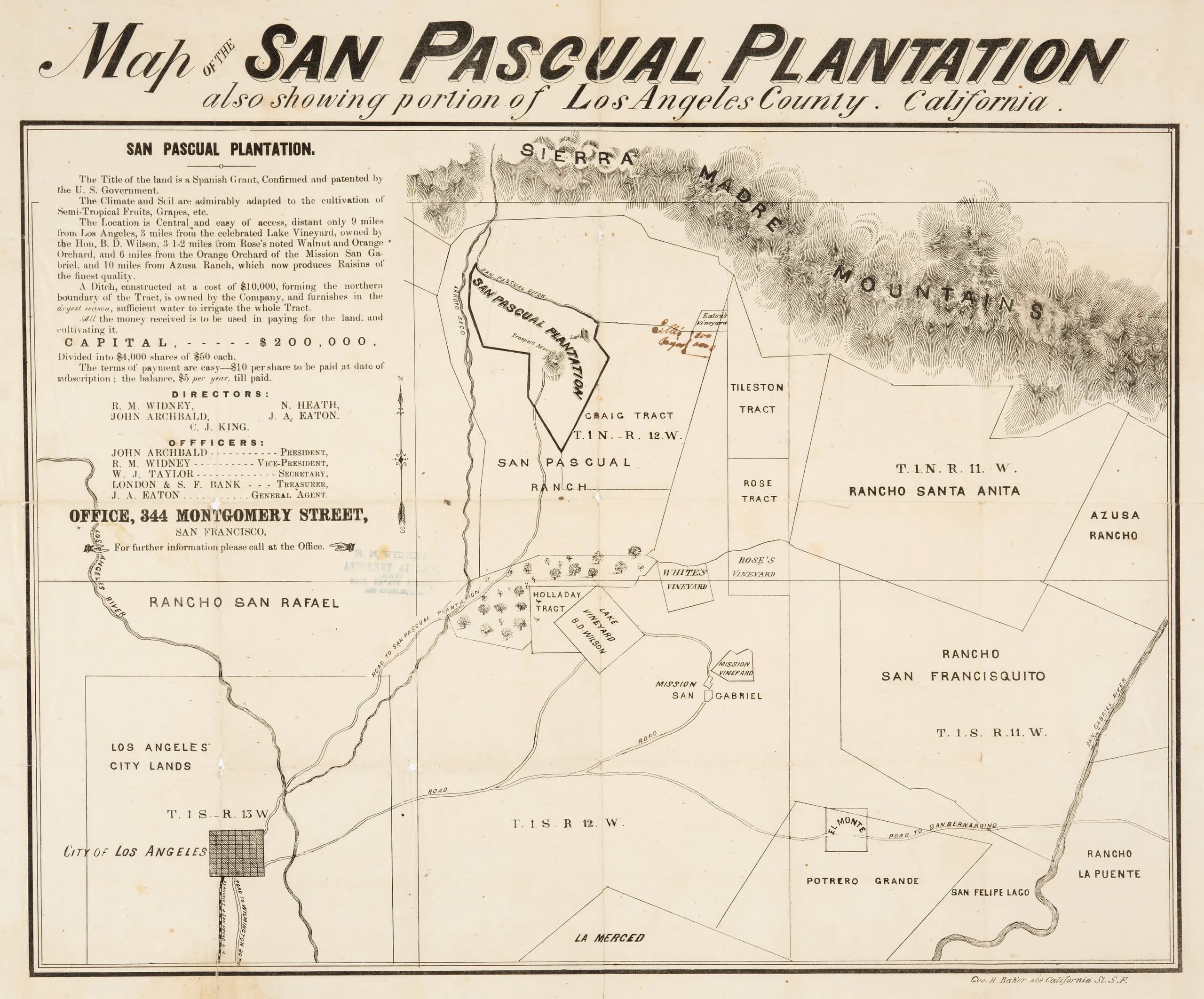
The mission system seeking to educate the natives was discontinued when Mexico declared its independence from Spain and took over Alta California and the land holdings contained therein. The system of land grants begun by Spain to reward its earliest soldiers upon retirement gave way to dissolution and division of mission lands and the scattering of the native populations who worked these most valuable of village sites. In 1833, Mexico freed itself from Spanish Governance and took over the land of Alta California. The first governor, Figueroa, granted the San Pascual ranch to Eulalia and her husband, Juan Marine. When they both passed away, the land was granted to Juan Perez and Enrique Sepulveda. By 1843, both had died and the land was granted a third time by the governor, this time to Manuel Garfias.
Nearly all good farming and ranching land in California was covered by deeded ranchos by 1850, when California is granted statehood. The boundaries of these large ranchos were blessed by the governor of Alta California at the time and granted to petitioners who were deemed worthy - nearly all retired military personnel from the DeAnza and Portola expeditions of the 1770's.
Before the gold rush in 1849, the non-native population of all of California was around 15000 people of Mexican and Spanish descent, the only people counted in any census taking of the times. There were probably around 100,000 surviving native americans who made it to the gold rush - 115,000 people across a land of over 160,000 square miles.
For perspective, in 2024, Altadena had a population of over 40,000 people in her scant 8 and a half square miles. The vast influx of gold seekers in such a short time frame completely overwhelmed the rancheros and their pastoral lifestyle. Soon they sold their vast herds to miners at good profits but were tasked with proving ownership of their vast ranch lands in a legal system with which they were not familiar. While most were successful, it came at great expense as they had to sell off much of their holdings to pay legal fees that ran from 5 to 15 years for confirmation.
In 1849, nobody lived in Altadena, it was part of a vast rancho owned by Manuel Garfias, and about to be sold to enterprising new arrivals, trappers and traders from the east coast and central states - the grandest of which married into Spanish society in the 1830s. Benjamin Wilson came to own the San Pascual Rancho and its upper northeast corner which would become Altadena when Garfias could not repay monies loaned to him to build his large adobe.
Wilson, or Don Benito as he was known, and Dr. John Griffin became owners of a vast tract of what they thought was dry and useless land - until Griffin's brother in law Benjamin Eaton became involved and managed to bring water out of the canyons at an elevation high enough to water the dry table lands below and reveal their value as rich farmland.
Dr John Griffin, a southern physician whose brothers in law were Confederate Civil War General Albert Sydney Johnston and Los Angeles judge Benjamin Eaton, was prominent in early Los Angeles. Albert Sydney and his wife Eliza were the first residents of this eastern side of Altadena and Judge Eaton built the first home for them under the oak trees between what is now New York and Washington Drive, just on the East side of Pepper. Fair Oaks was the name of their property for Eliza's home estate in Virginia. In a prelude of things to come, Eaton also planted and experimented with grapes with only mother nature irrigating them (dry farming they called it), but later bringing water from the canyon that bears his name to provide a steady supply and produce a superior fruit. The Allens would improve upon that but not until after the civil war and General Johnston being wounded and falling at the battle of Shiloh in 1862. A grief-stricken Eliza could stay no longer when her son was killed in a steamboat explosion in the Los Angeles Harbor just a year later. She left for Virginia and Eaton sold parts of the land where the Johnston's home was. Some of the parcel was sold to the Cranks, some to the Brigdens and a little piece at the top of the property to a WW Edwards who will sell to the Allens.
In 1879, the year in which William Allen will purchase the land that becomes his beloved Sphinx Ranch, all of Altadena has fewer than 100 residents and only 7 or 8 homes west of Lake. There are no businesses located in the area and there is no post office. These conveniences are available down the hill in Pasadena, a growing community of about 20 years at that point. Growing oranges and other fruits and both table and wine grapes are in vogue and newcomers like the Allens hoped to make their small fortunes with virgin lands and a healthful climate.
So as you stand wherever you are in the old boundaries of the Sphinx Ranch, look around you and imagine not a single home and all of the surrounding oak trees and occasional sycamore. Imagine native grass and poppies in profusion for as far west as you can see across the barren slope. There is only one road coming across the entire alluvial fan and it heads across Eaton's canyon mouth and arroyo to the sierra madre villa hotel, a sanitarium with a great reputation for healing tuberculosis sufferers. Other than that, just Ben Eaton's home and oak trees and some vines he was experimenting with...
Tour Route
You are here
Experience This Story On Location
Download the History Cake app to experience this story with automatic audio narration as you visit the location.