 Back to HistoryCake Driving Tour - Highway 14 and the 395 - Welcome and Overview
Stop 12 of 57
Muroc & Edwards: Where the Sky Cracked Open
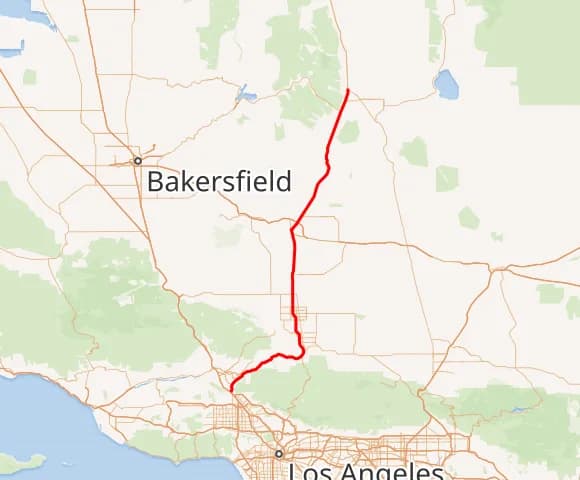
Off to your east, past Rosamond, lies one of the flattest places on Earth: Rogers Dry Lake. A homesteader's reversed name gave us "Muroc"; an Army bombing range gave us Edwards Air Force Base. Here Chuck Yeager first cracked the sound barrier in 1947, and space shuttles later glided home onto the lakebed.
CA1933-present (X-1 flight 1947)Written by historians, never AIResearched & written by Marc Striegel
In the app, this story plays on its own as you reach this spot. This page is the preview.
See the full tourListen
Narration
In the app, the full narration plays when you're on location.
The story
Muroc & Edwards: Where the Sky Cracked Open
Look east, out past Rosamond and the Joshua trees. Hidden beyond the low hills is Rogers Dry Lake, a 44-square-mile sheet of clay so flat that locals say it's "level as a billiard table." For thousands of years this was Indigenous country. The Kawaiisu, centered near Tehachapi, ranged east across the desert on gathering trips, while the Serrano, Kitanemuk and other Shoshonean peoples camped along the shifting shoreline of what was once a real lake. Archaeologists have logged over 450 prehistoric sites on this ground.
The modern name came from settlers. Around 1910 the Corum family homesteaded the lakebed and wanted a post office named for themselves. When the Post Office rejected "Corum" (too close to Coram, California), they simply reversed the letters: Muroc.
In 1933, Lt. Col. Henry "Hap" Arnold saw the dry lake as a giant ready-made runway and turned it into the Muroc Bombing and Gunnery Range. With 350 flyable days a year, it became the nation's secret proving ground. On October 14, 1947, Captain Chuck Yeager was air-dropped from a B-29 in the orange, bullet-shaped Bell X-1 he'd named "Glamorous Glennis" and became the first person to fly faster than sound, Mach 1.06, in the sky above this lakebed.
The base was renamed in 1949 for Captain Glen Edwards, a test pilot killed when the futuristic Northrop YB-49 flying wing broke apart near Muroc on June 5, 1948. NASA's Armstrong Flight Research Center (formerly Dryden) sits on the same shore. And from 1981 to 2009, Space Shuttle orbiters glided silently down to land here, fifty-four operational missions plus the early Enterprise tests, double sonic booms announcing each homecoming over the Mojave.

Almost here
Hear it where it happened.
The History Cake app is in the final stretch. Leave your email and we'll send one note when this story can play for you on the spot.
Be first in line
One email at launch. No worries, no spam.