 Back to HistoryCake Driving Tour - Highway 14 and the 395 - Welcome and Overview
Point of interest · Other
Randsburg
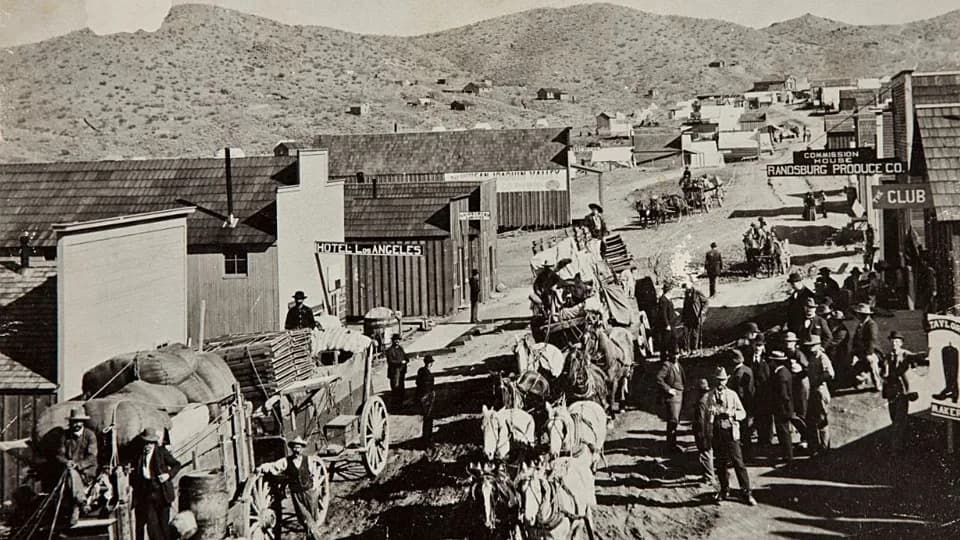
Off to the east lies Randsburg — one of the desert's great living gold-rush towns. Born from the rich Yellow Aster strike of 1895 and named for South Africa's Rand gold fields, it boomed, burned, and somehow never fully emptied.
Founded 1895Written by historians, never AIResearched & written by Marc Striegel
In the app, this story plays on its own as you reach this spot. This page is the preview.
See the full tourThe story
Randsburg
Off to the east sits Randsburg, one of the Mojave's rare living gold-rush towns. In April 1895 three prospectors — Frederic Mooers, John Singleton, and Charles Burcham — struck gold on the slope that became the Yellow Aster Mine. A camp boiled up almost overnight, and the miners named both it and the surrounding district "Rand," after the fabled gold fields of the Witwatersrand in South Africa.
By the end of 1896 the camp had been renamed Randsburg, and more than 1,500 people crowded its dusty streets. The Yellow Aster proved fabulously rich — by late 1897 the district had produced over half a million dollars in gold, and stamp mills pounded ore around the clock. Water was the perennial enemy, piped and hauled from wells miles away, and wages stayed low enough that the miners walked out on strike in 1903.
The Yellow Aster faded during the First World War and closed in 1918, but Randsburg refused to die. Its mines reopened and shut with the price of gold, silver, and tungsten across the decades, while neighbors like Johannesburg, Atolia, and Red Mountain dwindled. Today Randsburg is that rare thing — a gold camp that never fully emptied, its old saloon, general store, and weathered storefronts still lining the main street.
On the route
Where it sits
In the app, this stop triggers as you arrive.
You are here


Almost here
Hear it where it happened.
The History Cake app is in the final stretch. Leave your email and we'll send one note when this story can play for you on the spot.
Be first in line
One email at launch. No worries, no spam.