 Back to Historycake Landscape, Life and Mining/Geology Tour - Highway 395 and 14
Big Pine
A small Owens Valley town under the highest crest of the Sierra — home to the southernmost glacier in the US, a felled giant sequoia, and a 15-year-old Paiute girl who beat school segregation in 1924.
In the app, this story plays on its own as you reach this spot. This page is the preview.
See the full tourListen
Narration
In the app, the full narration plays when you're on location.
The story
Big Pine
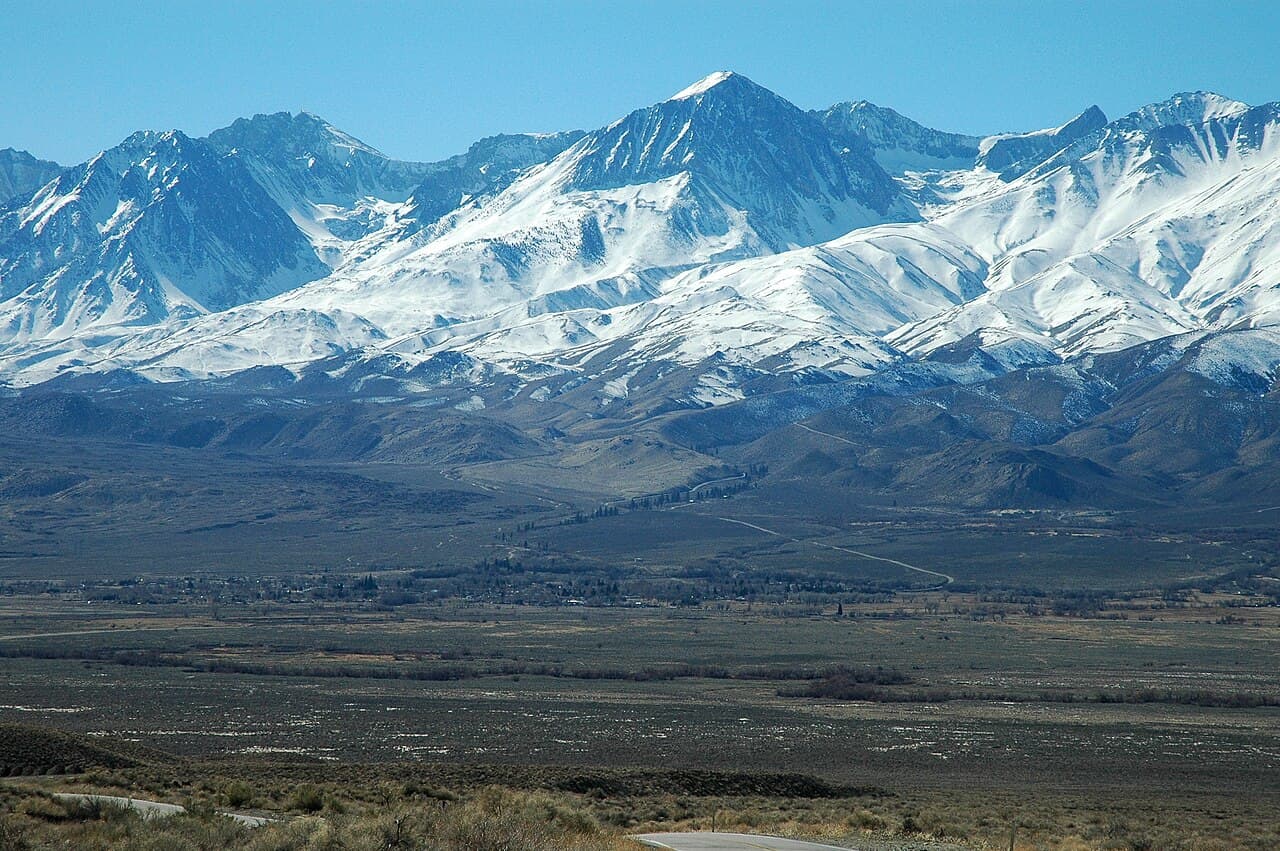
You're rolling into Big Pine, a town that punches far above its size. It took its name from a single large pine that stood here when the post office opened in 1870, and it still sits low — about 4,000 feet — beneath some of the tallest rock in California. Look up to your right at the Sierra crest: the jagged wall above is the Palisades, and tucked into its shadow is the Palisade Glacier, the southernmost glacier in the United States and the largest in the range. It has lost roughly 40 percent of its ice in living memory.
This valley belongs first to the Numu — the Owens Valley Paiute — who farmed it with irrigation ditches long before settlers arrived in the 1860s. The Big Pine reservation was established in 1912, just as Los Angeles began buying up the valley's land and water. The aqueduct that carried the Owens River south gutted the local farm economy, a wound the valley still feels.
One quiet act of resistance happened right here. In 1924, a 15-year-old Paiute student named Alice Piper sued the Big Pine school district after it barred Native children. The California Supreme Court ruled unanimously in her favor — holding that as the daughter of tax-paying citizens who lived off the reservation, she was entitled to attend the public school. It was an early desegregation victory, remembered as a forerunner to Brown v. Board of Education.
Watch for the road junction where a giant sequoia, the Roosevelt Tree, was planted in 1913 to mark the opening of Westgard Pass to automobiles. Drought finally killed it; it was cut down in 2020. East up that pass live the bristlecones, the oldest trees on Earth. And just south of town runs an earthquake scarp from the great 1872 Lone Pine quake.
On the route
Where it sits
In the app, this stop triggers as you arrive.
Out now
Hear it where it happened.
Get the free app, stand where this happened, and the story starts on its own.