 Back to Historycake Landscape, Life and Mining/Geology Tour - Highway 395 and 14
Agua Dulce & Vasquez Rocks
The Agua Dulce exit is the gateway to Vasquez Rocks, where tilted sandstone slabs mark the San Andreas Fault — Tataviam homeland, a bandit's hideout, and Hollywood's favorite alien planet.
In the app, this story plays on its own as you reach this spot. This page is the preview.
See the full tourListen
Narration
In the app, the full narration plays when you're on location.
The story
Agua Dulce & Vasquez Rocks
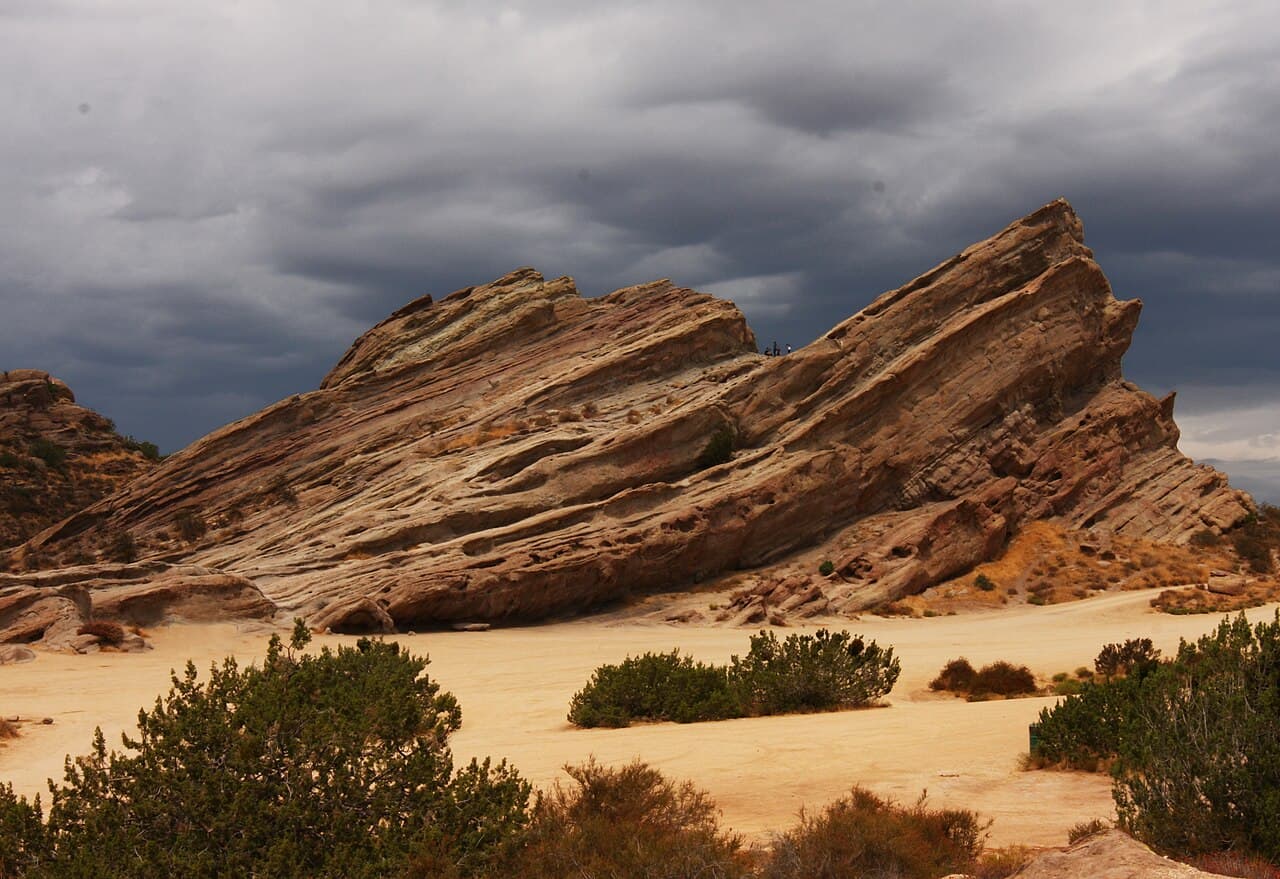
The exit here at Agua Dulce Canyon Road is the turnoff for one of the most photographed rock formations on Earth — Vasquez Rocks, a mile or so north. Look east as you pass and you may catch the sharp, tilted slabs of buff sandstone tipped skyward at impossible angles. They're hogback ridges, beds of ancient stream gravel and sand shoved up and rotated by the Elkhorn Fault, a strand of the San Andreas system that runs right through this valley. The tipping started roughly 25 million years ago as the Pacific and North American plates ground past each other, and the same fault is still nudging the rocks today.
"Agua Dulce" means sweet water. The Spanish soldier Pedro Fages camped at a spring near here on March 6, 1772, tasted it, and the name stuck for two and a half centuries. Long before that, this was Tataviam country — their village of Mapipinga sat among these rocks, drawn by reliable water, shelter, and the soft Sierra Pelona steatite they carved into bowls and traded from the coast to the desert. After 1797, Spanish missionaries pulled many Tataviam to Mission San Fernando.
The rocks take their name from Tiburcio Vasquez, the Californio bandit who used these crags to dodge posses in 1874. He claimed his robberies were revenge for Anglo land-grabbing; a jury saw a killer, and he was hanged at San Jose on March 19, 1875. Hollywood found the formation in the 1930s, and it has stood in for the Old West, the prehistoric past, and countless alien worlds — film fans know it as "Kirk's Rock" from the original Star Trek. Same stone, a hundred different planets.
On the route
Where it sits
In the app, this stop triggers as you arrive.
Out now
Hear it where it happened.
Get the free app, stand where this happened, and the story starts on its own.