 Back to Historycake Landscape, Life and Mining/Geology Tour - Highway 395 and 14
Mojave Air & Space Port: Where Spaceflight became private
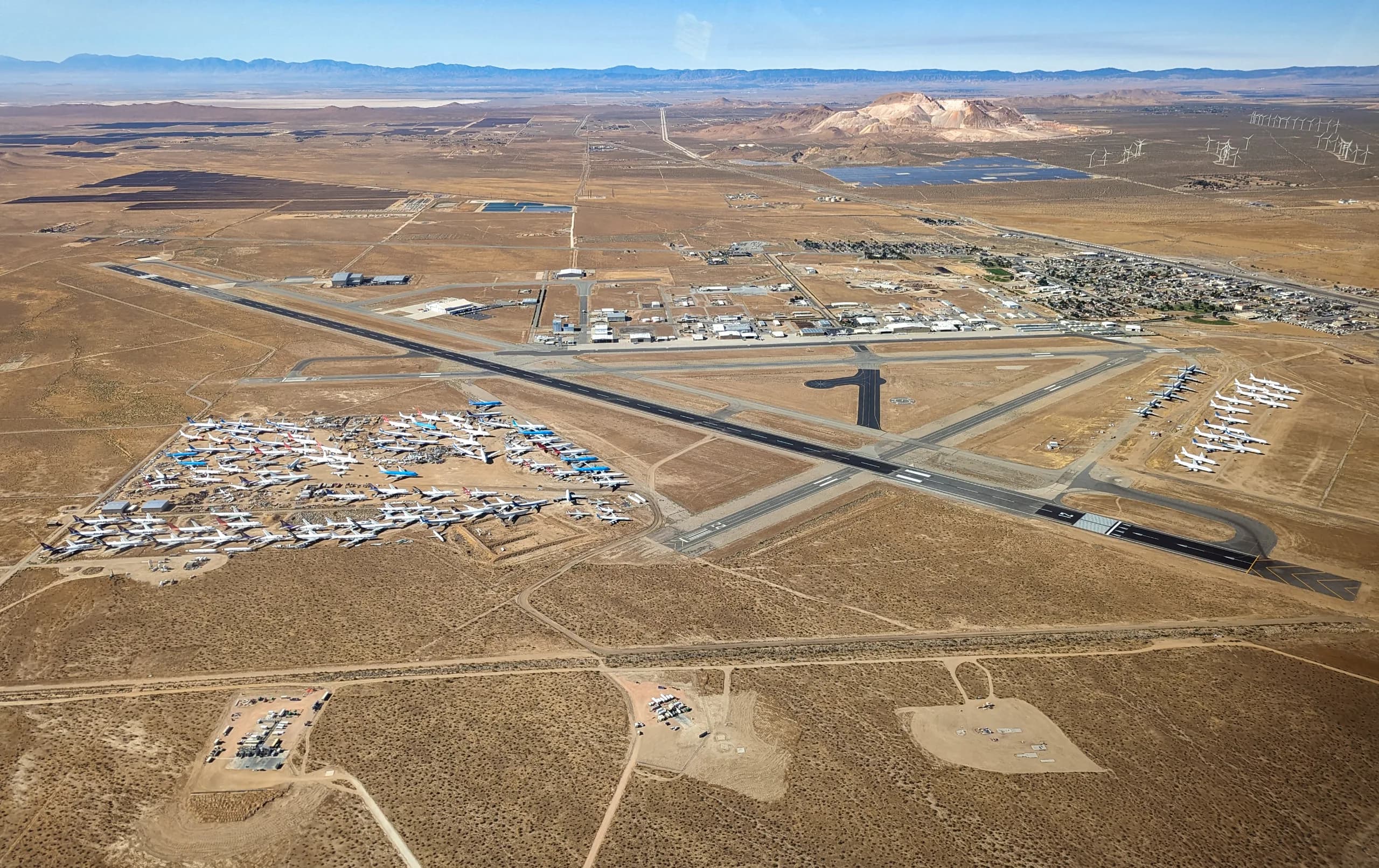
Off to your east sprawls the windswept airfield where, in 2004, a privately built rocket plane slipped past the edge of space and won the $10 million Ansari X Prize. Beginning as a WWII Marine gunnery base, today it's an aircraft scrapyard, a flight-test arena, and, she is America's first inland spaceport.
In the app, this story plays on its own as you reach this spot. This page is the preview.
See the full tourListen
Narration
In the app, the full narration plays when you're on location.
The story
Mojave Air & Space Port: Where Spaceflight became private
Look east across the runways and you're seeing one of the strangest, most consequential patches of desert in America. Kern County first scraped two dirt runways down here in 1935 to better serve the gold and silver mines that drew people to Mojave in the first place. Then came the second world war in 1939.
After Pearl Harbor the U.S. Marine Corps took the field, and in July 1942 began building it into Marine Corps Auxiliary Air Station Mojave.
At its peak the Marine base sprawled over 2,300 acres and housed around 145 aircraft. Some of the Marines' best fighter aces honed their aerial gunnery in these skies before shipping out to the Pacific. The base was closed after the war, then reactivated for Korea, and finally handed back to civilian hands in 1961.
The dry air and emptiness and nearby flat dry lakebeds that made Mojave good for gunnery or emergency landings also made it perfect for two other things: parking airplanes in an environment that slowed aging and testing the wild birds.
The same desert that preserves rows of retired airliners in the boneyard also drew flight-test legends like Burt Rutan, whose Scaled Composites set up shop here. Rutan's team built SpaceShipOne.
On June 21, 2004, pilot Mike Melvill rode SpaceShipOne to 100.124 kilometers, just past the recognized boundary of space, becoming the first person ever to earn astronaut wings aboard a privately funded craft. That fall, two more flights within two weeks claimed the $10 million Ansari X Prize. Days before that first flight, also in june of 2004, you are driving by nation's first FAA blessed inland spaceport.
Gallery
From this place
On the route
Where it sits
In the app, this stop triggers as you arrive.
Out now
Hear it where it happened.
Get the free app, stand where this happened, and the story starts on its own.